Showing posts with label technology. Show all posts

Friday, November 16, 2012

Chroma Key: Transforming green into wonders


Filmmaking is not only an art. In the last 40 years, filmmakers has invented and developed new technological advances, creating a dynamic, non-stop process that is still being developed nowadays. Improvements in editing, cinematography, lighting and makeup have been improved successfully. However, the most known achievement may be visual effects.

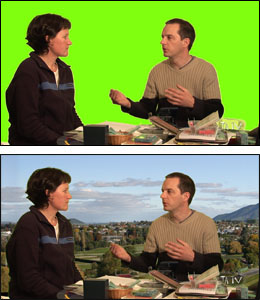
For this branch, a primal creation was the chroma key. This widely known technique consists of using a green or blue screen as the backdrop for the scenes, and then the colors are replaced for images developed in a computer. This technique can be applied in flat surfaces, and shaped elements as well.
Green screen used in Harry Potter and the Deathly Hallows - Part 2

 A curiosity about this technique is that has been everlasting. Since its invention in 1933 and improvement in the 70s, only the software and applications used to put the image in the screen have been changed. Fortunately, the applications have enough to develop a thorough result in image, making it to be quite similar to the reality. The success in terms of image for films like Star Wars, Avatar or Alice in Wonderland is the product of the use of this technique. Thanks to this technique, filmmakers have also developed motion capture, which is making technological elements out of current films.

Considering that this technique has replaced several film labors like art direction, do you think that is a good element in filmmaking? What is your opinion on visual effects on movies? For more information check the site of KEYLIGHT, a keyer software for blue and green screen, and the video of the use of chroma key for visual effects in Tim Burton’s Alice in Wonderland.


Thursday, November 15, 2012

Cloning humans for organ transplant? Nah, thanks, I'll just have it printed :)

Cloning humans to solve the lack of organs for transplant seems to be a good idea since long lists for transplant are no close to an end.

An American company is making good progress on a new technology that might be the key to solve the tedious problems of organ transplant. The technology that this company is using, is the one that prints 3D copies of organs that are totally functional in the human body.

So far, this technology allows to create only organs like the skin, because more complex organs need to be created with very small features like blood vessels, detailes that this technology is unable to do. Of course in the future, the possibility of reaching the level of creating more complex organs is very high.

In this video you can see how the process is done.


http://www.youtube.com/watch?feature=player_embedded&v=sWyeO4oxVtY

Although this tech is really amazing, it allows us to critically think about this topic of creating organs in a controlled environment, because just like cloning is a very controversial topic, because of the risks and the limits that humans may follow, this technology is very "dangerous" too, because if we keep moving forward with this, in the future we might be able to create a human being, just like now we create organs like the skin.

What's your stance on this topic? Do you think that this technology can become something "dangerous"? Do you think that nature, and biological processes related to procreation, will not be needed any more? In case you are in need of an organ, would you agree on receiving and lab-created one?

We can keep on asking lots of questions, but the thing is that medicine and technology are making gigantic steps in this field, and you never know what is going to be the next thing that is going to surprise us all.

Here's another video related to the topic that provides more information, enjoy.

http://www.ted.com/talks/anthony_atala_printing_a_human_kidney.html

Sunday, November 11, 2012

Do you want to improve your appearance? Then play Second Life as soon as possible!


Nowadays, looking good  has become almost a necessity for human beings, and there are several ways to achieve it, but can a videogame help in this pursue?
A study conducted by a team of scientists from University of Missouri suggested that the more a person feels indentified with a virtual alter-ego, the more it could influence his or her personal image.  For instance, people who want to lose weight could create a slim online avatar in order to envisage themselves as thinner.
279 users of the virtual game Second Life (similar to The Sims), were asked to respond a survey regarding their engagement with their virtual alter-ego and relationships they developed online, in addition to their offline health, appearance and emotional well-being.  
The results showed that “A strong sense of self-presence in the social virtual world positively promoted health and well-being of study participants. People with high degrees of self-presence in the cyber world reported that their experience with their avatar improved how they felt about themselves offline. Self-presence also correlated to greater satisfaction with online relationships.” (Retrieved from http://munews.missouri.edu/news-releases/2012/1105-virtual-reality-could-help-people-lose-weight-fight-prejudice-says-mu-researcher/)
However, it is well known that spending several hours in front of the computer can be harmful for health. Sedentariness is associated with obesity, heart diseases, high blood pressure, diabetes, etc.
Exercise and good alimentation are the basis for a healthy life, according to the American College of Nutrition and most of doctors around the world. 

To read the abstract of the study, click here

Is it possible that a computer game such as Second Life can promote a healthy life?

Sunday, October 7, 2012

"If this does not blow your mind, then you have no emotion"

A lot of people, specially us teachers and people who feel identified with Humanities more than with hard Sciences, have struggled at least once with mathematical problems. As we were still in school, educational institutions and teachers were unable to do much for the students who needed longer time to understand a given task and were forced to continue with the next one, leaving a bunch of their students frustrated for not understanding and at disadvantage among their peers who managed to reach the objectives in time.


In 2004, Salman Khan made a huge discovery. He started posting math tutorials in YouTube for his nephews, as he was tutoring them from a long distance. Shortly after, other users of the popular video site started posting him comments and thanking him, because his videos helped their children understand mathematics. At that point he realized that he had found a great teaching tool still not fully exploited.

Now in 2012, there are more than 3,400 videos that can be found in Khanacademy.org along with math exercises generators displayed in a game-like fashion to make them more engaging. Teachers can tell their students to do all the exercising they need at home at at their own pace and use the time at school for experimentation, humanizing the classroom.

This system is already being applied in different schools in USA, and, hopefully, we can expect to find it in a school near us soon. As Bill Gates said, this is the future of education. Wouldn’t you agree?


Technology for the differently abled


Nowadays, people with physical disabilities have a hard time keeping up with the times, as their limitations will not allow them to have access to certain services and technologies, including computers and the internet. Luckily, a group of Chilean students came up with a solution for them, so that disabilities will not limit their access to technology and, therefore, to social integration. 


Last year, a group of three computer science students from Federico Santa Maria Technical University developed LifewareIntegra, a program that allows handicapped people to use computers. They combined a head device with sensors, that are able to pick up brain activity, and software, that interprets this information, to let the user have full access to a computer and its applications through a set of tools developed by its creators. The head device was originally created for gaming purposes, but these students had the vision to give it a whole new purpose.


LifewareIntegra was tried for the first time on Jenifer Astorga, a 26-year-old woman who lives with quadriplegia. The test was a huge success and she seemed really happy afterwards. If the software is further developed, it might one day help a lot of other people like Jenifer to be rehabilitated and get a job.


Wednesday, October 3, 2012

Are you a ciber allergic?


Headaches, vomit, nausea and loss of short term memory are only some of the symptoms caused by an unknown and modern affliction that has been disturbing people for some years now, and even though it has not been certified by the World Health Organization, it seems to be here to stay for a long time and turn into a XXI century disease.

The “Wi-Fi allergy”, as it is known, is explained by an electro sensitivity caused by a prolonged exposure to electromagnetic fields but as is has not been worldwide certified, people who suffer from this are restricted to treat only the symptoms and do not joy the medical facilities every ill person should. Some of the testimonies reflect that it starts by being affected by waves emanated from the wireless router, but after a long period of exposure even the TV or anything that’s plugged can cause a reaction such as the already named.

Other of the reasons why it has not been formally considered is because, according to experts’ opinions, this type of exposure reduces considerably the production of serotonin in the brain; serotonin is a natural anti-depressive, so its low production can cause tiredness and sometimes sadness, reason why this electro sensitivity can also be mistaken as stress or depression in some cases.

It is also important to say that this modern disease appears at any stage of life so you better start setting boundaries with your technological gadgets before is too late, don’t you think so?

Sunday, September 30, 2012

Motion capture in the creation of "Just Dance"


Many are the technological techniques that have been developed for several industries. One of them is the motion capture. This process, also known as “mocap” consists of recording the movement of an object or people; this recording is used later to create digital versions of what was recorded. Film, animation and games industry are pioneers using this technique—although it is a very useful tool in sports, medicine, robotics, even in military issues.

During last 3 years, a video game developer, Ubisoft, has used this technological tool in an “unusual” way: record movements for you to follow them. In 2009 a new game for the Wii was released by this French developer. The game named Just Dance consists of mimic a silhouette of a dancer, which is created through motion capture, using the standard Wii remote. This game featured a wide range of very-known songs, each one with a different choreography. This, combined with the benefits of an active and “healthy” game, made the game a complete success; in fact, there are 2 sequels already released and a fourth one coming in October.

This revolutionary idea was achieved thanks to LiveMove, software used specifically for Wii games whose special characteristic is that it can record very fast dance steps and movements without losing the quality of the motion—other techniques create motions that look too “computerized”. Because of this, imitating the steps involves less effort and players feel more comfortable playing the game.

Motion capture in video games industry is, perhaps, making a change developing games that may contribute to health rather than only entertaining. Could you as gamers prefer these games instead of the ordinary ones? You can check the link below (a video from a song of Just Dance 3) and think about it.


Saturday, September 29, 2012

Smartphones Addiction: Do you really know your limits?

Twelve years ago, the only utility of cell phones was to make calls and to text messages. In that time, people were amazed with the possibility of talking through a “small” device from any place there were antennas nearby.  However, time advanced and so did technology; new features started being incorporated until cell phones became almost small laptops.
Nowadays, smartphones have become part of our lives.  Either to check our emails, to chat, to take photos, to read newspapers or to check twitter and facebook; we are using them the entire day because of a necessity of being connected.

However, it is said that several people around the world are becoming addicted to this devices. According to Lisa Merlo, Psychologist from the University of Florida, there is a series of behaviors regarding smartphones which may be alarming and signals of addiction; for instance, checking the phone every 5 minutes not only for missed calls, but also to catch up on anything that happens in social networks or emails; faking to do something on the phone to avoid contact with other people; getting into the phone and losing awareness of what is happening around; freaking out if the phone is left at home; among others.

The consequences can be sleep problems, increase of stress and nervousness, increase of dependence, lose of social skills and even extreme anxiety when the phone is not near.

In the next CBS News report, Betty Nguyen consults specialists about this issue.


What about you? Do you consider yourself as addicted to your smartphone? If you don't have one, would you like to?

Friday, September 7, 2012

Photoshop & Celebrities: Do They Share the Red Carpet?


Most people know Photoshop, and some of us even have this software in our laptops or computers. For those who do not know what Photoshop is, it is a software developed by Adobe Systems, an American computer software company, which major use is in editing images.

Many artists (and by artists I mean singers, dancers, actors, etc.) are fond of Photoshop and they find it a good opportunity to look attractive for their fans. At the same time, they supply their need of looking as young and nice as in the moment they became famous, and project an image of immortality and everlasting beauty and fame, although the image they show is an idealistic version of them.

Photoshop at its best: Madonna, singer

But when is it too much? Some artists have overused this useful tool turning it into an enemy that reveals their necessity of others’ recognition, not only in the artistic field (the one that really matters), but also in the physical and superficial field. Singers and actors tend to use Photoshop as if it was the only mechanism to attract the masses, sometimes with unsatisfactory results.

Another example of Photoshop: Tyra Banks, model

From bigger breasts and smaller waist to different skin color, artists have used this now worldwide famous software to make fans and public in general feel attracted to first impressions, and in this case Photoshop is the right weapon to draw our attention to them. But what would happen if there was not any software to edit one’s appearance? Would beloved celebrities be as popular as they are now?

P.S. If you want to watch Ellen DeGeneres talking about Photoshop (hilarious!), click here.


Thursday, August 30, 2012

Cellphones, useful even to make a call.


Cellphones. How much time can we stay away from a cellphone these days? We use our cellphones to set our alarms, to write down our to-do lists, to take pictures, to record videos and sometimes, even to make a call or send a text message (haha). I’ve heard some stories from my grandfather in which he tells about how people “survived” thirty years ago without a cellphone.  They had to organize all their meetings several hours before the time by the phone and they were supposed to be punctual as they were not able to let their friends or bosses know they were arriving late. Nowadays, it’s hard to believe that someone could have organized his/her entire life without a cellphone’s help.
At the beginning, the cellphone was a brick look-like device that was used only to make calls and send text messages. From a one colored-screen technology the cellphone went to full colored screens. Nowadays, cellphones even count with 3D technology so we can watch TV or movies in our cellphones! These devices are an important part of our lives during these days. It is very common to see 10-yearls old kids carrying a cellphone on the streets, calling their friends, playing video games and so on so FORT. We cannot imagine one day without our beloved cellphone.
Cellphones are very useful and, at the same time, very fun to use. But, we should be more aware of the real use of these devices. Sometimes, it becomes more important to be able to watch TV in a cellphone than to have good signal in order to make calls. Technology is consuming us, and we are doing nothing but texting how fun it is to be consumed.