Showing posts with label Chile. Show all posts

Friday, November 16, 2012

Chilean children are as happy as Swedish children !


It has always thought that living in Europe provides you socio-economic stability and their standard of living is way better than other continents as America or Africa, but having and enjoying all the facilities and amenities does not make you happy, do they?

Children who live in Sweden, the fourth happiest country of the World according to UN, are as happy as Chilean children. The study was headed by Los Andes University, together with Swedish and American researchers who evaluated the level of vital satisfaction among 729 Chilean children between 8 to 14 years old, from private, subsidized, and municipal schools; and the data of 623 Swedish students.

According to Lisa Clefberg, director of department the Psychology from the fore mentioned University, children’s opinions were recollected and evaluated into ten different areas of satisfaction: parents, friends, siblings, health, home, self-respect, school, teachers, cousins, and time of playing.

“The results are very impressive and strong. We thought the results of UN would reply on the Swedish Children too, but we found that they feel very unsatisfied in many aspects in comparison to the Chilean Children” tells Dr. Clefberg. For example, one of the aspects that shocked the psychology community was “siblings”, in which Chilean children obtained higher scores than their European pairs.   

What about you? What’s your opinion regarding this topic? Does the socio-economic stability have to do with the happiness of people? Feel free to comment.

In this link you will find a blog attached from the Austin Psychology and Assesment Center. They expand on the possible reasons in children from Netherlands (another European country) for being happy. 

Sunday, November 4, 2012

Chagas: The Unknown Death

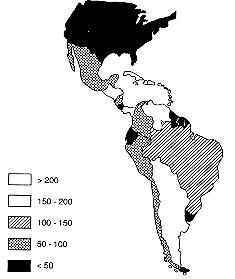
Estimated incidence of Chagas disease in the Americas

It is known how insects can be vectors for terrible diseases. Yellow fever and malaria are evidence of that. But, have you have ever heard about Chagas disease?

Considered the “Aids of Latin America”, this disease is caused by Trypanosoma cruzi, a protozoan transmitted to humans by several insects. These insects bite a human to feed on its blood. Then, the human scratch the bite and that gets the T. cruzi into the person’s blood.  Chagas disease is so lethal because the protozoan attacks the nervous system, the digestive system and heart. In addition, symptoms for its chronic stage can only be seen after many years (about 10 to 20 years later). And, of course, the result will be always the same: death.

Chilean vinchuca (Triatoma infestans)
Believe it or not, Chile is hometown for this disease. It is transmitted by “vinchucas” (Triatoma infestans): insects which live mainly in rural areas. Chagas was considered eradicated in 2000. Nevertheless, in 2002 the Ministry of Health started a campaign to teach people how to prevent this deadly disease. This campaign was released in hospitals from rural areas because of the characteristics of the disease. However, experts have stated that this disease is not a “countryside illness” anymore, because vinchucas are adapting to live in urban areas. In fact, this statement is becoming stronger nowadays because of several cases detected in urban and pre-urban places.

Chagas is perhaps a disease which has not been studied enough, even though has deadly consequences. Should this disease remain so unknown? Do we need more studies about it? How can we take responsibility in order to prevent this disease? For more information check the links below:

- An article by the Daily Mail about Chagas disease in America.


- A news report by American broadcast company Univision (Spanish language)

Sunday, October 7, 2012

Technology for the differently abled


Nowadays, people with physical disabilities have a hard time keeping up with the times, as their limitations will not allow them to have access to certain services and technologies, including computers and the internet. Luckily, a group of Chilean students came up with a solution for them, so that disabilities will not limit their access to technology and, therefore, to social integration. 


Last year, a group of three computer science students from Federico Santa Maria Technical University developed LifewareIntegra, a program that allows handicapped people to use computers. They combined a head device with sensors, that are able to pick up brain activity, and software, that interprets this information, to let the user have full access to a computer and its applications through a set of tools developed by its creators. The head device was originally created for gaming purposes, but these students had the vision to give it a whole new purpose.


LifewareIntegra was tried for the first time on Jenifer Astorga, a 26-year-old woman who lives with quadriplegia. The test was a huge success and she seemed really happy afterwards. If the software is further developed, it might one day help a lot of other people like Jenifer to be rehabilitated and get a job.