Showing posts with label controversy. Show all posts

Wednesday, November 14, 2012

Are you sure probiotics are good for you ?


Have you ever paid attention to yogurt’s labels? If you haven’t, maybe you would be surprised of the amount of different components that this products may have.  Some of the most popular are the “probiotics”, which are supposed to bring benefits to our health. But, do you think this is true?
Probiotics are live micro-organism whose function is to restore the balance of intestinal bacteria, and raise resistance to harmful germs. If you take them in sufficient amount, they can improve digestive health, and even help colds by shorten their duration.
The controversy surrounding this topic started due to there is no standard labeling requirement to help buyers to identify clearly which probiotics are they consuming. Many milk products have the word “probiotic ” on their labels, but that is not enough: there are thousands of kinds of probiotics; however, only a few of them have been proved effective in clinical trials.
Dannon, one of the biggest sellers of probiotics yogurts, had to face a legal case and pay $35 million settlement to reimburse dissatisfied consumers of its Activia yogurts and DanActive yogurt drinks. Although Dannon's web page presents several scientific studies as evidence of their patented probiotics strains, the products’ labels do not show in a clear way which probiotics the consumers are ingesting and what their specific function is. The danger of this practice is related to some reactions, especially allergies, which the consumers may have after consuming the product. In that way, a probiotic can become a risk rather than a benefit. 
From now on, are you going to read labels? Do you think it is important for consumers interested in probiotics to look for products that list the specific strain on the label?

Watch this video about how probiotics work!

Wednesday, October 3, 2012

Microwave ovens are dangerous: True or false?


Have you heard about the controversy of using microwave ovens? In the past, it was believed that microwave radiation was dangerous because this would not be contained within the oven. For this reason, American manufacturers of microwave ovens had to demonstrate to the FDA (U.S. Foods and Drugs Administration) that microwaves, produced by a magnetron inside the oven, pass through plastic and glass containers, and are absorbed by the food. In that way, it is impossible to think that these waves could go out and cause damage because they are inside the food. But, if the waves are in the food, what do we eat when we eat microwaved food?

There are a lot of people that are against using microwave ovens. They posit that these ovens are unsafe because they alter food composition, producing toxins or carcinogens that may affect our body. In 1991, the Dr. Hans Hertel, a well-known Swiss food scientist, conducted a study comparing the effects of microwaved and non-microwaved foods in humans. The results showed that blood samples obtained from the participants that ingested microwaved food had significant changes. These anomalies included a decrease in hemoglobin and lymphocytes, and an increase in hematocrit, leukocytes and cholesterol values.

These registers could make evident that microwaved foods cause the degeneration of the human health; however, this study, and some other related to the same topic, have never been published in scientific journals, so there is not enough evidence to prove that microwaves are hazardous. And the controversy continues, and maybe, it will never stop.

Do you think microwave ovens are dangerous?

Thursday, September 20, 2012

Embryonic Stem Cells Research: Abortion or Scientific Progress?


You probably have heard the term “stem cells”. Nowadays, it is mentioned on TV, newspapers and internet quite often since this kind of cells are said to be the possible “cure” for many diseases. For the ones who do not know, a stem cell is a “neutral” cell which is able to grow within any other specialized cell. So, when a specialized cell, e.g. a skin cell, is damaged or missing, a stem cell could repair or replace it. 

Two categories of stem cells can be identified: “embryonic” and “adult”. Basically, the “embryonic” are the ones found in an embryo when it is just a few days old. The “adult” stem cells are neutral cells found in tissues and organs. The problem is that this type of cells is not as versatile and obtainable as embryonic stem cells; therefore, they may not be really helpful for research.

Although most of embryonic stem cells are obtained from embryos that develop from eggs fertilized “in vitro” (and donated for research purposes), religious groups are against their use since they maintain that human life begins at the moment of conception; therefore, scientists would be killing potential human lives.


Groups in favor allege that life starts just when there’s activity registered in the brain (20 weeks approximately after conception).  Furthermore, embryos need to be transferred into a woman’s uterus in order to develop into a person.

Is an early embryo a real person?  Or should we care more about the possible treatments that could be developed from this kind of research?
                                                                                                                                                                                             

Sunday, September 9, 2012

The LHC: The "Life Hazard Cause"?


            This is obviously not what “LHC” stands for, yet not only a vast number of people from the scientific community but also civil people may actually consider this name a suitable choice; the erection of the Large Hadron Collider (LHC), the largest particle accelerator in the world—and highest-energy one as well—began in 1998 in the frontier between Sweden and France—close to the city of Geneva—and finished four years ago by the CERN (Conseil Européen pour la Recherche Nucléaire [European Organisation for Nuclear Research]).
            The pursuit for hints that can lead these nuclear scientists to the discovery of the key constituents of matter, the scrutiny in the course of a possible set of hidden dimensions, and the unearthing of the tremendously sought-after Higgs Boson, which is considered the elemental particle of the substance of the whole universe (i.e., the very origin of it), are the major purpose of the construction of this 27-kilometre cylinder.
            Nevertheless, these tempting raisons d'être became nothing against the terror unleashed a few years ago by the time the LHC was set into gear; this colossal particle accelerator has been said to be the potential reason of the end of the world. How is this possible? Why was this sort of massive destruction weapon built, knowing that it could mean the end of life in planet Earth as we know it?
            This controversy came out in 2008 when a group of scientists presented their complaint to the court of the CERN after having made some speculations about the possible creation of antimatter or black holes, which means that the Earth—probably along with other planets and satellites—would get absorbed and destroyed.
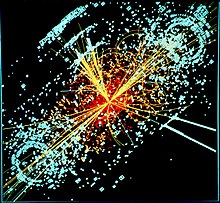
In simple terms, what happens inside the LHC is a series of ‘mini-big-bangs’ that are supposed to last a few seconds and then vanish into thin air—something that has not been proven yet, which has caused this hullabaloo. However, these speculations seem not to have any mathematical support and scientists affirm that there is not anything to be concerned about.